The Scottish Play: Macbeth

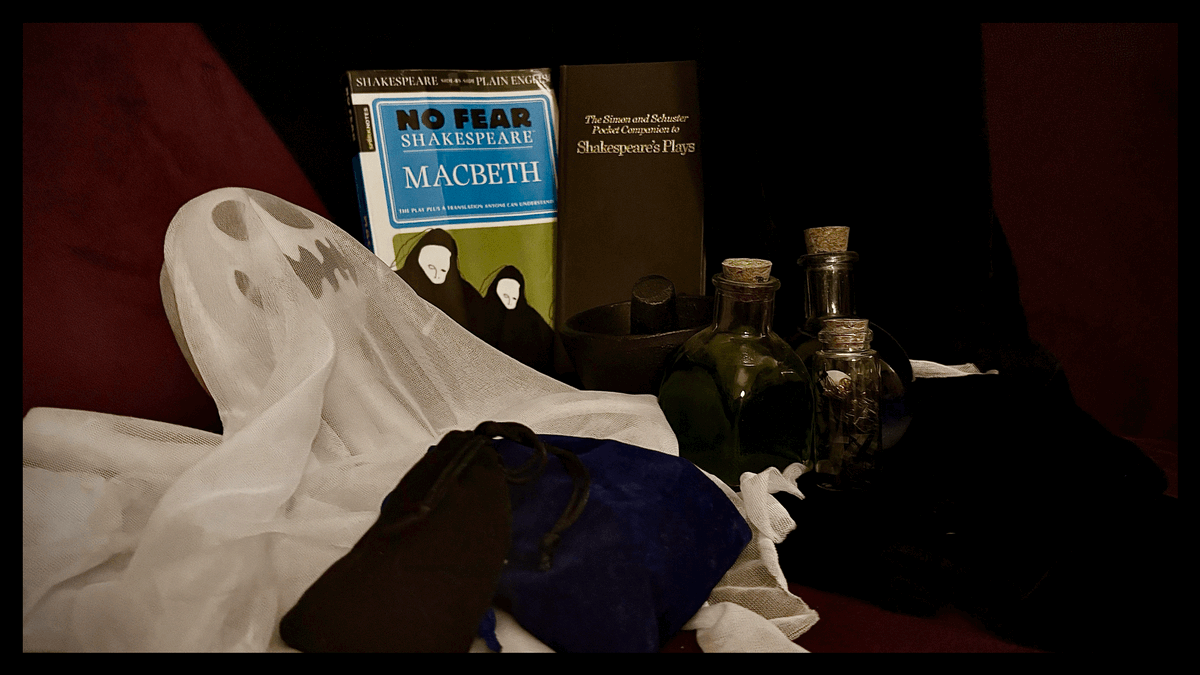
Wow! What a crazy switch up from YA to Shakespeare! That's part of what I love about this project. I get to read all sorts of books I never would have picked up on my own!
If you want to read this book on your own, go do it! It's a good read! In the meantime, you can find my other book reviews here:
Time to face the book I was supposed to read in 10th grade English but never did.
Title: Macbeth
Author: William Shakespeare
Publication Date: 1623*
Pages: 214**
Genre: Classic, Play
My Rating: 4/5
Goodreads Rating: 3.89/5
*Thought to be first performed in 1606.
**For this book I used Sparknote's No Fear Shakespeare, which provides a side-by-side translation in plain English. The page count is 219. 214 is the number provided by goodreads.
I also used The Simon and Schuster Pocket Companion to Shakespeare's Plays to help with additional information. This is a fantastic source and I recommend it to anyone who enjoys reading Shakespeare and wants to delve into some of the history behind it.
A full summary and analysis
CAPTAIN
For brave Macbeth—well he deserves that name—
Disdaining fortune, with his brandished steel,
Which smoked with bloody execution,
Like valor's minion carved out his passage
Till he faced the slave;
Which ne'er shook hands, nor bade farewell to him,
Till he unseated him from the nave to th' chops,
And fixed his head upon our battlements.
(1.2.16-23)
---
CAPTAIN Brave Macbeth, laughing at Luck, chopped his way through to Macdonwald, who didn't even have time to say good-bye or shake hands before Macbeth split him open from his navel to his jawbone and stuck his head on our castle walls.
(Sparknotes translation, pg. 5)
Act 1: A bewitching beginning
In medieval Scotland, King Duncan hears good news of the Thane of Glamis, Macbeth. He fought valiantly against rebels and Norwegians to keep his crown safe, including killing the Thane of Cawdor who was also a rebel. In honor of his accomplishments, King Duncan bestows the title Thane of Cawdor to Macbeth and sends messengers to deliver the good news.
Macbeth and his friend Banquo, however, are busy being proselytized to by witches. The witches tell Macbeth that he will become Thane of Cawdor (something Macbeth is not yet aware of) and will eventually become King. They tell Banquo that his descendant will become King, but he will not be. The witches disappear quickly after giving the news, and almost comedically enters the messenger to tell Macbeth he is now Thane of Cawdor.
Macbeth, who almost immediately has homicidal thoughts, sends a letter to his wife, Lady Macbeth, about his new title and the witches prophecy, which causes Lady Macbeth to almost immediately have homicidal thoughts. Macbeth enters and tells his wife that King Duncan will be arriving that night to celebrate Macbeth's feats and new title, and Lady Macbeth says that they're gonna kill him in his sleep.
At night, Macbeth is growing anxious and rethinking their course of action. He shares his fears with Lady Macbeth, who emasculates him and calls him a coward which is enough for Macbeth to go through with the plan.
MACBETH I am settled, and bend up/Each corporal agent to this terrible feat./Away, and mock the time with fairest show./False face must hide what the false heart doth know.
(1.7.79-82)
---
MACBETH Now I'm decided, and I will exert every muscle in my body to commit this crime. Go now, and pretend to be a friendly hostess. Hide with a false pleasant face what you know in your false, evil heart.
(Sparknotes translation, pg. 47)
Act 2: Breaking bad (the phrase not the TV show)
It is past midnight and Macbeth is preparing for the murder of Duncan with a long monologue that includes this banger of a line:
MACBETH I go, and it is done. The bell invites me./Hear it not, Duncan, for it is a knell/That summons thee to heaven or to hell.
(2.1.62-64)
---
MACBETH I'm going now. The murder is as good as done. The bell is telling me to do it. Don't listen to the bell, Duncan, because it summons you either to heaven or to hell.
(Sparknotes translation, pg. 53)
The translation isn't as poetic, but I figure most of the people who read these posts aren't reading Shakespeare very often.
Lady Macbeth is waiting for her husband's return by drinking, which she claims to make her more powerful. When Macbeth does return, his hands are covered in blood and he is carrying the murder weapon. He tries to confide in his wife about the harrowing experience, and she basically says "whatever, don't worry about it." She tells Macbeth to return to the scene and cover the sleeping servants with blood to frame them, and Macbeth says he cannot. Lady Macbeth calls him a coward and does it herself.
Macduff and Lennox, two nobleman who accompanied the King are awoken by a porter (a door keeper) who is completely wasted. After a discussion including eight lines about how hard it is to have an erection while drunk, Macbeth enters, trying to act cool. Macduff goes to wake the King and discovers his lifeless body. The King's party is horrified by the news, but agree to discuss it once they are not in their pajamas. Duncan's sons, Malcolm and Donalbain, decide to flee the property in case of danger with the former going to England, and the latter to Ireland.
Macduff reports to Ross, another nobleman, what has been decided: the servants (that Macbeth immediately killed upon "discovering" Duncan's body) had been paid to commit the treason, and Malcolm and Donalbain are suspected to be the traitors. With no other nobles left in his way, Macbeth is on his way to be crowned King.
Intermission: I thought this was supposed to be a tragedy?
I don't know much about Shakespeare, but I do remember from high school that he wrote comedies and tragedies. I thought that these two categories were dichotomous and there would be no funny business in this play. I was wrong. There were a few times already that I laughed out loud.
The scene of the nobleman discovering Duncan's death has some great lines:
LADY MACBETH What's the business,/That such a hideous trumpet calls to parley/The sleepers the house? Speak, speak!
MACDUFF O gentle lady,/'Tis not for you to hear what I can speak:/The repetition, in a woman's ear,/Would murder as it fell.
Enter BANQUO
O Banquo, Banquo,/Our royals master's murdered!
(2.3.78-85)
---
LADY MACBETH What's going on? Why is that terrifying trumpet calling together everyone who's sleeping in the house? Speak up and tell me!
MACDUFF Oh gentle lady, my news isn't fit for your ears. If I repeated it to you, it would kill you as soon as you heard it.
BANQUO enters.
Oh Banquo, Banquo, the king has been murdered!
(Sparknotes translation, pg. 71)
And,
DONALBAIN What is amiss?
MACBETH You are, and do not know 't./The spring, the head, the fountain of your blood/Is stopped; the very source of it is stopped.
MACDUFF Your royal father's murdered.
MALCOLM Oh, by whom?
(2.3.93-97)
---
DONALBAIN What's wrong?
MACBETH You are, but you don't know it yet. The source from which your royal blood comes has been stopped.
MACDUFF Your royal father is murdered
MALCOLM Who did it?
(Sparknotes translation, pg. 73)
Again, the translation doesn't hit as hard as the actual line.
I went into this book not really knowing what to expect and anticipating being a bit bored, but scenes like these were delights to read. I guess unless I saw this play performed, I wouldn't know if they're usually played straight or comedically, but in my mind they're such good lines of comic relief in a play that has been pretty intense most of the time.
Okay, I have one quote where the translation is better than what's written:
BANQUO Were such things here as we do speak about?/Or have we eaten on the insane root/That takes the reason prisoner?
(1.3.84-86)
---
BANQUO Were these things we're talking about really here? Or are we both on drugs?
(Sparknotes translation, pg. 17)
Act 3: Is Macbeth on drugs?
Act 3 opens with a bit of a time skip, but it does not say explicitly how much time has passed. Banquo is filled with doubts about the murder of Duncan and suspects Macbeth may have had a role in it due to the prophecy that was given by the witches. But he has no time to act on his thoughts as he takes off on a short journey with his son, Fleance.
Macbeth and Lady Macbeth prepare for a feast they are hosting that night, and while Lady Macbeth is showing some regret about their murder plot, Macbeth is starting to turn towards the life of violence. Paranoid about the witches proclaiming Banquo's descendants to be king, he hires three murderers to attack Banquo and his song when they return to the palace. Banquo dies, but his son Fleance flees the scene in time.
At the dinner party, Macbeth starts to having troubling visions. He sees the ghost of Banquo sitting on his throne and shouts at him, trying to justify his actions. Lady Macbeth tries to get him to calm down, but he is plagued by these delusions. The nobleman are concerned about their king, but Lady Macbeth says he has a disorder and not to worry about him, in fact, questioning him or looking at him makes it worse! Lady Macbeth says he needs sleep, but instead Macbeth says he will go to the witches in the early morning to get more answers.
Lennox, one of the nobleman from before, is talking with an unnamed lord about his growing doubt of Macbeth's innocence. I would also be suspicious if two high ranking lords were claimed to be murdered by their sons and one person stands to gain everything from it. Macduff, who is also suspicious of Macbeth, had traveled to England to find Malcolm and refuses to return to Scotland, but Lennox sends him a message, asking him to free Scotland from its tyranny.
Intermission: The curse of Macbeth
Ever wondered why Macbeth is referred to as "The Scottish Play"? Legend says it's cursed! Shakespeare did a lot of research on witchcraft while writing this play, and it's said he used real witches spells. Due to their spells being revealed, it angered the witches so much that even saying the name of the play will bring bad luck to any performer.
So why does this rumor exist? Well, the play has had a tumultuous history starting from the very first production. The actor who was supposed to originate the role of Lady Macbeth died unexpectedly and Shakespeare himself had to cover the part. It's also said that the prop knives that were used to kill Duncan were not actually props at all and killed him in the process. Though, other sources claim this happened in a production ~70 years later.
Then in 1849, there was the Astor Place Riots in New York that resulted in over 120 injuries and at least 20 deaths. The riot caused military intervention which lead to the most military-caused deaths since the Revolutionary war and was the genesis for higher police militarization. The cause? Uh... two actors playing Macbeth in competing productions were arguing about who was better. Of course there is more context around this, but that's pretty much what it boils down to.
In a production in 1937, a heavy weight fell from the wings landing only a few inches away from the actor playing Macbeth, who had also lost his voice before the incident. In that same production, the theater manager died of a heart attack and a prop sword flew out of an actors hands and into the audience, injuring an audience member.
There have also been reports of mysterious deaths and injuries in many productions since the first show in 1606 to present day, including a negative critic who died a week later, a Lady Macbeth falling into an orchestra pit, a production being postponed due to the director getting a case of shingles, an actor falling off his bike and breaking his arm on the way to the theater, an opening night being canceled due to many of the productions members being hospitalized for food poisoning, an actor being actually stabbed in a sword fighting scene causing his death, a Macbeth suffering heart failure and dying on stage at the beginning of Act 3, an actor receiving severe burns from tights soaked in kerosene, and:
The 1988 Broadway production went through 3 directors, 5 Macduffs, 6 cast changes, 6 stage managers, 2 set designers, 2 lighting designers, 26 bouts of flu, torn ligaments and groin injuries.
(Thomson Jaffe, https://tinyurl.com/mtjssu3k)
Most recently, in 2025, a feminist retelling of the play was postponed when a key actor dropped for personal reasons a week before opening day, which was supposed to be Friday, the 13th. Not as violent as the other cases, but maybe it's a sign the curse of waring off.
Additionally in less violent news, because of the notoriety of the play and it being a fan favorite, a theater or company announcing they're putting on Macbeth is seen as a sign that the theater is about to close.
To speak for a less mystical argument for these injuries, because Macbeth is such a popular play there are bound to be injuries and accidents associated with it through the centuries. Macbeth is not the only production that has had bad luck associated with it and unfortunately, there will be unavoidable tragedies in the future of theater. While I don't know the statistics on injuries in the theater compared to injuries in Macbeth, I don't think your high school or college production will have many issues.
It's also important to note the rise of witch hunts during the time of Macbeth's original production. Witchcraft was just starting to become a serious issue to people in the 1600's, so it's no wonder the rumor of Shakespeare's play being cursed came to fruition.
If you're performing this play and make the grave mistake of uttering "Macbeth," don't worry! There is a solution! Exit the theater, spin around three times, spit on the ground, say a curse, quote Hamlet, and then knock on the door to be invited back in.
And if you're in the theater and don't believe in the curse, have respect for your fellow cast and audience members and just avoid saying the word anyway.
Act 4: Witches ain't shit and they ain't sayin' nothin', a hundred mothafuckas can't tell me nothin'
Act 4's kinda short, so I'm sorry you only get a little bit of plot in between my ramblings. Speaking of ramblings, did you know it's suspected that what we know of Macbeth is a reduced version of the original play? Additionally, in original performances there would be up to three intermissions and 20 scene breaks! The play can already be anywhere from 1.5-2.5 hours long nowadays, but my ADHD self would probably enjoy all of the breaks. Anyway, back to it.
Like he claimed the night before, Macbeth visits the witches early in the morning, demanding they tell him more about his future. Instead of just telling him, they conjure three ghosts. The first tells him to beware Macduff, the second says that no harm will come from someone born from a woman, and the third tells him he has nothing to worry about until the forest marches to fight him on Dunsinane Hill. Macbeth is relieved to hear all of this as most of it seems improbable, but he still must know if Banquo's children will come to reign after him. The witches warn him, but he insists. Eight ghost kings march out, all looking from the same lineage; the future descendants of Banquo. Some seeming more successful than Macbeth.
Lennox comes to deliver the news to Macbeth that Macduff has fled to England. Heeding the witches warning, Macbeth orders for Macduff's castle to be ransacked and his wife and children murdered. The crazy part about all of this? Macbeth doesn't have any children. He's usually played in his mid-30-40's, but not once in the play is it alluded to that he longs for children. So who's going to take over his line anyway?
MALCOLM
I grant him bloody,
Luxurious, avaricious, false, deceitful,
Sudden, malicious, smacking of every sin
That has a name. But there's no bottom, none,
In my voluptuousness. Your wives, your daughters,
Your matrons, and your maids could not fill up
The cistern of my lust, and my desire
All continent impediments would o'erbear
That did oppose my will. Better Macbeth
Than such an one to reign.
(4.3.58-68)
---
MALCOLM I admit that he's murderous, lecherous, greedy, lying, deceitful, violent, malicious, and guilty of every sin that has a name. But there is no end, absolutely none, to my sexual desires. Your wives, your daughters, your old women, and your young maids together could not satisfy my lust. My desire would overpower all restraints and anyone who stood in my way. It would be better for Macbeth to real than someone like me.
(Sparknotes translation, pg. 161)
In England, Macduff tries to convince Malcolm to fight for his rightful throne, but Malcolm seems resistant. He claims he would be too lustful, too greedy to be king. Macduff believes Scotland to be doomed until Malcolm says "jk I'm a virgin and that's the first time I've ever told a lie in my life." Not his exact words, but that's the gist. Malcolm agrees to fight with them, saying the King of England has already given him 10,000 troops. And off they go to face Macbeth.
Intermission: Random things I looked up while reading
What is a Thane? A thane is a member of Scottish nobility, similar in ranking to a baron or knight. They hold land in exchange for military service to the king. Or nowadays more of like a governor.
Who is Bellona? Bellona is mentioned in a passing simile in the first act, but I was curious who they were referencing. She is the roman goddess of war and often depicted as a wife or relative of Mars. It's thought that she had a cult that worshipped her and it gained so much popularity that the Romans ordered her temple destroyed.
What is a hautboy? This is an instrument that is often used when royalty are entering a scene. It is a predecessor to the modern day oboe that translates roughly to "high woodwind." Because of its volume, it was often used in outdoor ceremonies.
What is Colmekill? After his death, Duncan's body is said to be carried to Colmekill, a holy resting place for kings. More commonly known as Iona and originally being the center for early gaelic christianity, it is an island to the west of Scotland that was pillaged and occupied in a Viking raid in 802. It was freed from Norwegian control in the early 1200's and established an abbey. Nowadays, it seems like it's mostly a tourist site with only ~170 residents and over 130,000 tourists a year. The small diverse community is the heart of the Celtic christianity revival and offers Christians a new way to praise in today's world.
Act 5: Ambition is my folly
The first scene of act 5 is of Lady Macbeth sleepwalking and trying to wash her hands of the blood that has stained them, but no matter how much she wrings her hands a spot still remains. Her hand maiden and a doctor overhears her confessions of murder, but they just put her back to bed and pray she can find peace.
The war is starting and Macbeth is going mad. He fears his power being usurped, but is calmed by the prophecy of the witches. He's also told that his wife has committed suicide and he does not care at all. Then, a messenger reports he has seen the trees moving closer. You see, Malcolm and his army covered themselves in leaves and branches to hide their marching through the forest. The leap into action and attack the castle. Macbeth and Macduff meet in combat and Macbeth reveals that he will not be killed by him because he was born from a woman. Macduff then reveals the truth of his birth:
MACDUFF Despair thy charm,/And let the angel whom thou still hast served/Tell thee, Macduff was from his mother's womb/Untimely ripped.
(5.8.13-16)
---
MACDUFF You can forget about your charm. The evil spirit you serve can tell you that I was not born. They cut me out of my mother's womb before she could bear me naturally.
(Sparknotes translation, pg. 213)
Macduff kills Macbeth and carries his head. Malcolm becomes king and all is well.
...
But what about the "Banquo's descendants will become kings thing"? Well turns out King James I, who the play was originally performed for, was said to be a descendent of Banquo and that plot line was thrown in there as flattery. Kinda lame in my opinion.
What was the point of the witches?
You can take the witches out of this story and there would be no difference. Honestly, I think the story would thrive without it. Without the witches, we could see how ideas of grandeur can corrupt morally strong-willed people. How violence perpetuates violence and how easy it is to fall into tyranny when you hold so much power.
But I believe it was King James I that first put witchcraft into the mainstream. He was fascinated and terrified of witches, and so it seemed was Shakespeare. So I guess just throw it in. To be fair, because of it we have the witches chorus from the Verdi opera which makes it kinda worth it.
Conclusion
Well that ended up being more fun than I thought! It was cool being able to delve into the lore of this book and have an excuse to research things I never would have thought to research otherwise! My main complaint was that the ending was kinda lackluster, but it's a script and I'm sure on a stage it's much more interesting.
Next time, back to YA! I decide what book to read with the help of a random number generator, but I'm enjoying the classics so I might have to pick up a couple more from my library. If you have any recommendations from the game, let me know!
